Employee-related costs (including compensation and benefits, commissions, and stock-based compensation) accounted for
roughly two-thirds of our overall cost structure in 2021, and, through the first nine months of 2022, that
proportion was generally consistent. These costs per employee fell modestly during the first nine months of 2022
compared to the prior year period, due in part to foreign currency impact. After accounting for currency and
adjustments for M&A-related costs, earnouts, and the reduction and shift of our China operations,
employee-related costs per an average employee count were close to flat. The prior year bonus, resulting from strong
performance relative to target in that period, created favorable variance for the year-to-date, which was offset by
increases in other employee-related costs, including stock-based compensation.
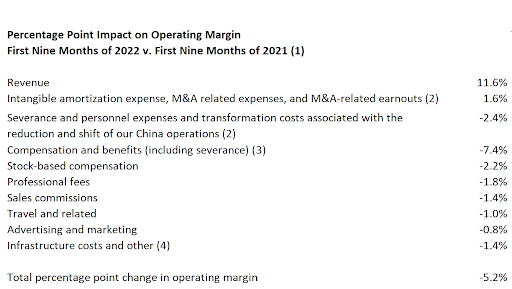
Our operating margin declined from 14.7% for the first nine months of 2021 to 9.5% for the first nine months of 2022,
a decline of 5.2 percentage points. The drivers of the change in operating margin are presented in the table below:
- These non-GAAP measures may not be comparable to similarly titled measures reported by other companies. We
present adjusted operating margin to show the effect of significant acquisition activity, better compare
period-over-period results, and improve overall understanding of the underlying performance of the business
absent the impact of acquisitions.
- These expenses are added back in our calculation of adjusted operating income and are excluded from the
categories that follow.
- Compensation and benefit costs include salaries, cash bonus, and company-sponsored benefits as well as severance
expenses (excluding those related to the shift of our China operations).
- Includes infrastructure costs such as third-party contracts with data providers, AWS cloud costs to house data
collection and products, and subscriptions to SaaS-based software, as well as facilities, depreciation, and
capitalized labor.